.webp)
Reporting should make client conversations much easier. But the opposite happens for many agencies.
You put in a lot of time preparing SEO reports every month. The client then skims the file, focuses on one metric, and asks questions that were already answered in the report.
That back-and-forth adds friction to your relationship, even though the work was done well.
White label SEO reports help fix this.
A good report shows what changed, why it changed, and what should happen next. It makes expectations visible and keeps conversations focused on progress.
In this guide, we walk through how agencies create white label SEO reports. You will learn what to include, how to structure each section, how to choose the right KPIs, and how to scale reporting.
There’s also a free template you can adapt to your own clients!
TL;DR
If you want the short version, here is what matters:
- White-label SEO reports are agency-branded documents that explain performance.
- They work best as monthly or quarterly summaries with context and priorities.
- They follow a fixed structure that clients can recognize every time.
- Each tracked and presented KPI should support business goals.
- Dashboards handle monitoring. Reports handle interpretation and next steps.
- Agencies that standardize structure can reduce reporting time without lowering quality.
- The free template included here is designed to scale across different client types.
What Are White Label SEO Reports, and Why Do Agencies Use Them?
White-label SEO reports are client-facing reports delivered under your agency’s brand and brand colors. They combine SEO performance data with explanation, context, and recommendations, without exposing third-party tools.
Instead of asking clients to interpret charts on their own, the report walks them through what matters and what does not. It also keeps the conversation focused on progress and priorities.
What “White Label” Means In Client Reporting
White label reporting is not just adding your company logo to a file.
It’s branded SEO reports that look and sound like they came from your agency. The structure, language, and emphasis reflect how you think about performance.
It also means you control the narrative. You decide what deserves attention and what stays in the background. Charts support the explanation instead of replacing it.
The report is intentional, guided, and should create confidence for clients.
Why Agencies Rely On SEO Reports
Agencies rely on white label SEO reports because they reduce friction.
Clear reporting helps with client retention. When clients understand results and trade-offs, they ask fewer reactive questions and trust the process, especially when reports focus on the metrics that matter.
An SEO Marketing Benchmark Report 2025 shows that poorly executed reports create confusion, while clear and insightful reports improve client confidence and retention.
Reports also support consistency. A fixed structure makes delivery easier across accounts, even as the agency grows.
They also help with commercial conversations. Renewals and quarterly reviews are smoother when the report already ties work to outcomes and next steps.
What Clients Expect (Even If They Don’t Ask For It)
Clients rarely ask for better reports. They ask better questions when reports are unclear.
They want to know what is working, what is not, and what should happen next. They also want context when numbers change, especially when performance slows.
When reports fail to answer those questions, clients attempt to fill in the gaps. That is where misalignment and scope creep usually start.
A strong white label SEO report prevents that with a good design.
Pro tip: If you are considering outsourcing or expanding your white label SEO offering, this list of top white label SEO companies is a good place to see which providers specialize in this type of setup.
When Should You Use White Label SEO Reports Instead of Dashboards?
SEO dashboards and reports are not interchangeable; they solve different problems.
For instance, custom SEO dashboards are great for a quick check of numbers. Reports are there for context, direction, and decisions. Most agencies end up using both, but not for the same purpose.
Here is how to tell when a white-label SEO report makes more sense than a client dashboard:
Reports As Decision Documents
White label SEO reports are crucial when the goal is decision-making. They are ideal for stakeholders who want answers and care about outcomes and priorities.
Reports also fit naturally into monthly and quarterly cycles. A month of structured data gives enough signal to explain trends, trade-offs, and impact. That cadence makes it easier to talk about progress and next steps.
In fact, AgencyAnalytics benchmarks report found that most agencies share results with clients every month, and 57% of clients prefer a static report paired with a scheduled meeting. That combination gives structure and clarity.
Dashboards As Monitoring Tools
Dashboards shine when teams need ongoing visibility.
Internal teams use them to monitor performance, spot issues early, and check progress between reporting cycles. T
But, as a client deliverable, dashboards have limits. Metrics are easy to misread without context. Clients can focus on one dip or one spike and miss the bigger picture. Over time, this leads to cherry-picking and reactive conversations.
That does not mean dashboards are bad; they just are not enough on their own.
The Hybrid Setup Agencies Use
Most agencies land on a hybrid setup.
Dashboards provide transparency and live access for clients who want it. Reports provide a summary, interpretation, and a clear action plan.
In fact, the same AgencyAnalytics report shows that 49% of clients like having live dashboard access in addition to their regular reports. The key is the separation of roles: dashboards show what is happening, and reports explain what it means.
What Sections Should Every White Label SEO Report Include?
A good report feels familiar. Clients know where to look and what to expect.
This comes from structure. Every white label SEO report should follow the same core sections, even if the details change by client.
Here is the structure we see works best:
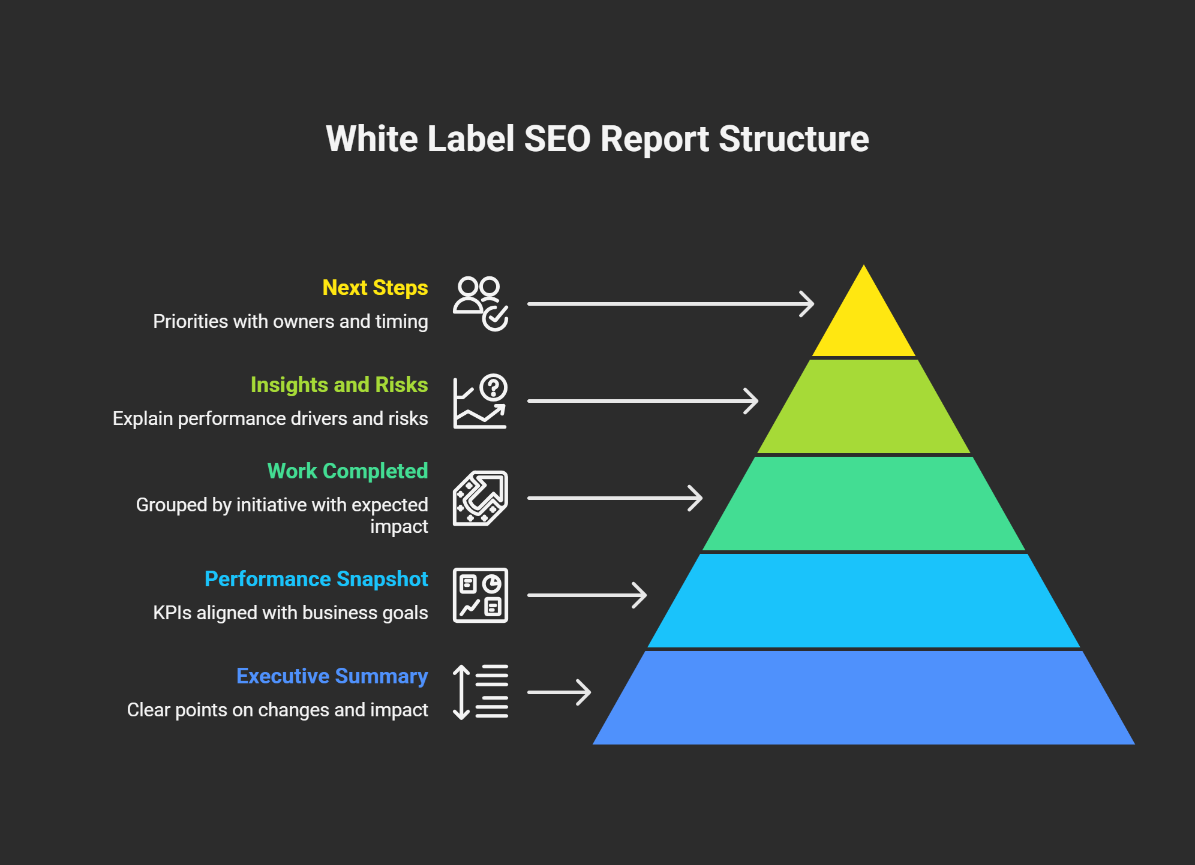
Executive Summary
This is the most important section. Many clients will only read this.
Keep it to three to five clear points:
- What changed compared to the last period?
- Why did those changes happen?
- What had the biggest impact on results?
- What needs attention right now?
- What comes next?
Avoid details here and focus on clarity. If someone reads only this section, they should still understand what happened that month.
Performance Snapshot
This section shows how performance moved.
Choose KPIs that align with business goals. Use consistent comparisons, such as month over month and against a baseline.
Fewer metrics work better; each number should earn its place. Clear callouts help guide attention so clients do not have to guess what matters.
Work Completed
Clients want to see what was done. Group work by initiative instead of listing tasks:
- Technical
- Content
- On-page
- Authority or PR
- Local SEO, when relevant
Tie each group to intent or expected impact. This helps clients connect SEO efforts to outcomes.
Insights And Risks
This is where the report adds real value.
Explain what moved performance and why. Call out external factors like seasonality, SERP changes, or site releases.
Also, be honest about risks. Tracking gaps, technical debt, and content decay are easier to manage when they are visible. Hiding them only delays the conversation.
Next Steps
End with direction. List three to seven priorities at most. Assign owners clearly, agency or client. Note dependencies and timing so expectations stay realistic.
This section turns reporting into a working plan.
Pro tip: Strong SEO reporting works best when it connects content work behind it. Reviewing how SEO content services support performance can help frame results more clearly.
How To Choose Relevant KPIs For Your Report?
Choosing the right KPIs is what turns a white label SEO report into something your client actually understands and values.
Relevant KPIs connect your SEO work to real outcomes, such as visibility, traffic quality, and conversions. They answer your client's questions, support their goal, and demonstrate progress.
KPI Selection Principles
Always start with outcomes.
Every key performance indicator should connect to a business goal like leads, revenue, or pipeline. If a metric does not help explain movement toward that goal, it probably does not belong in the report.
You should also keep definitions stable. KPIs should mean the same thing month after month. Changing definitions midstream makes trends useless.
Structure also matters here. Some metrics show the result, like revenue or conversions. Others hint at what’s next, like visibility on high-intent pages. When you mix them in a report without explanation, the story gets harder to follow, which results in a lot of questions.
KPI Sets By Business Model
Different businesses need different signals. That does not mean reinventing the report every time. It means adjusting the KPI block.
For local services, focus on:
- Calls and form submissions.
- Google Business Profile actions.
- Local visibility.
- Service-page performance.
For e-commerce, prioritize:
- Revenue and transactions.
- Category-level visibility.
- Product page entrances.
- Non-brand organic clicks.
For B2B and SaaS, look at:
- The demo or trial starts.
- Performance of high-intent pages.
- Topic cluster visibility.
- Pipeline touchpoints, when available.
The structure stays the same: the KPIs change to match how the business makes money.
Metrics That Require Careful Framing
Some metrics are easy to misread.
Rankings can improve without bringing the right traffic. Organic traffic can grow without turning into results. And visibility scores only help when their meaning is clear.
These metrics can still be useful; they just need framing. Explain what they represent and what they do not.
Pro Tip: When choosing what to highlight in your reports, it helps to understand which SEO efforts tend to drive real returns. These SEO ROI statistics provide valuable context when deciding which metrics to prioritize.
How Should White Label SEO Reports Be Written And Structured?
Even strong and structured data fails if the report is difficult to read.
Structure and writing style matter as much as the numbers. The goal is to guide the reader and make all information easy to understand.
Structure For Skim Readers
Most clients skim before they read.
Lead with outcomes and decisions. Put detail in secondary sections or appendices. That way, readers can go deeper when they want without getting lost.
Clear headings and predictable sections help clients find what they need fast. Over time, this familiarity reduces questions and follow-ups.
Commentary That Adds Value
Every chart should answer four simple questions:
- What changed?
- Why did it change?
- How does it impact the business?
- What happens next?
This is where the agency earns its role. Explain trade-offs and constraints calmly. If something underperformed, say why and what is being adjusted.
Clients value honesty more than perfect numbers.
Visual Discipline
Less is more.
Use one chart per takeaway. Keep consistent formatting across clients and months. Avoid clutter and raw tool screenshots that force clients to interpret data on their own.
Clean visual data presentation supports the story.
What Makes a White Label SEO Report Feel Truly Agency-Owned?
Clients can tell when a report is generic. Even if the data is correct, something feels off.
An agency-owned report feels intentional. It reflects how you think, how you prioritize, and how you work with clients.
Here is what creates that difference:
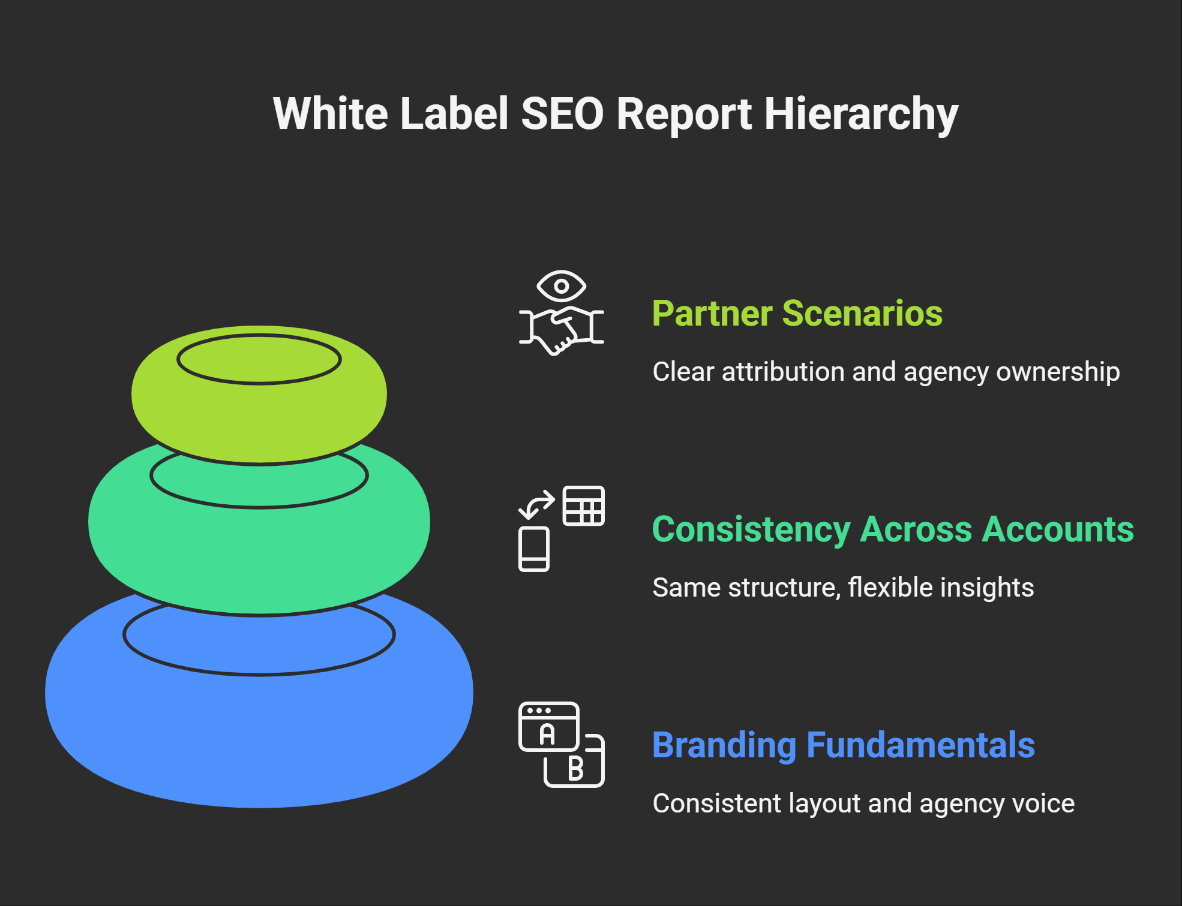
Branding Fundamentals
Branding is the baseline, not the differentiator, but it still matters.
Every report should clearly show:
- A cover page with the client's name and the reporting period.
- Consistent layout and section labels.
- Language that matches your agency’s voice.
Avoid tool-native wording. Clients should never feel like they are reading a platform export with your logo pasted on top.
Consistency Across Accounts
This is where many agencies hesitate. They worry that standardization will make reports feel templated. In practice, the opposite happens.
The structure stays the same across clients, which creates familiarity. It’s the insight that changes.
KPIs change depending on the business. Commentary adapts to each client. Priorities shift based on goals and constraints.
The framework stays fixed, so thinking can stay flexible.
Partner And Co-Branded Scenarios
In partner or reseller setups, clarity matters even more.
Define attribution upfront. Make sure the report does not feel like it came from a vendor behind the scenes. The agency should remain the owner of the narrative.
When roles are clear, trust stays intact, and conversations stay focused on outcomes.
How Can Agencies Produce White Label SEO Reports Faster Without Losing Quality?
Speed becomes a problem once reporting starts competing with delivery. The goal is to remove unnecessary work. Let’s see how:
Standardize What Should Never Change
Some things should stay the same:
- The report structure.
- KPI definitions.
- Naming conventions.
- The QA checklist.
When these are fixed, teams stop rethinking the same decisions every month. That alone makes reporting smoother and easier to manage.
Automate Data Collection, Not Interpretation
Automation features are useful when they save time, not when they replace thinking.
Let it gather the data and keep inputs consistent. Then pause. The analysis, priorities, and next steps need a human point of view. That balance keeps reports clear, reliable, and easy to trust.
Optimize Workflows
Simple workflows scale better. A reliable sequence looks like this:
pull data > validate > analyze > compile > review > deliver.
Assign a single owner per report. Add one internal QA step. Avoid passing the report across too many hands.
AgencyAnalytics’ benchmarks also show why this matters. Most agencies spend 15 to 30 minutes creating a client report, with 22% taking less than 15 minutes.
Pro Tip: Reporting is easier to standardize when it aligns with how your SEO packages are structured. Clear scopes make reports easier to scale across clients.
Which Tools Support White Label SEO Reports, and Where Do They Break Down?
Tools help, but they are not the solution by themselves.
Most reporting issues do not come from a lack of platforms. They come from using tools without clear roles or expectations.
Here is how agencies generally use tools:
Core Data Sources
Most white label SEO reports pull from a small set of reliable sources.
Analytics platforms help you understand traffic and conversion trends. From there, Search Console adds context around visibility and how users interact with search results. Rank tracking then shows how keyword positions shift over time. Finally, crawlers and performance tools offer a high-level view of site health.
You do not need every data source in every report. Use only what helps explain performance and decisions.
Delivery Formats
The format you choose shapes how clients experience the report.
Slides work best when the report is meant to guide a conversation, especially during review calls. PDF reports make sharing and archiving simple.
Docs or Notion pages are useful when clients want to leave comments, ask questions, or collaborate directly.
Some agencies also use white labeled reporting views as part of a hybrid setup. This can work well, as long as the report still explains what matters. The moment clients are pushed into raw data, clarity drops.
Tool Tradeoffs That Matter
No reporting setup is perfect.
More automation usually means giving up some flexibility. More control can slow things down. And because of sampling or attribution logic, different tools may not always show the same numbers.
Instead of hiding that, it is better to explain it. When clients understand what each tool is meant to answer, those differences feel like context, not mistakes.
Pro tip: Keeping up with trusted SEO blogs helps you stay current on how agencies think about reporting, tooling, and performance interpretation.
What Reporting Mistakes Damage Client Trust?
Trust rarely breaks all at once. It fades through small issues that repeat over time.
Most reporting mistakes are not dramatic, just easy to miss and easy to normalize, which is why they do so much damage.
Common Mistakes
These issues show up in similar ways across many reports. The most common ones look like this:
- Overload
Too many metrics with too little explanation force clients to guess what matters.
- Inconsistency
KPIs change month to month, comparisons shift, and definitions are unclear. Over time, trends become harder to trust.
- Avoiding negative results
When dips are softened or skipped, the clients notice it. Silence creates more doubt than an honest explanation.
- Ending the report without clear next steps.
Without owners or timelines, progress feels vague and unfinished.
Simple Corrections
The fixes are usually simple.
Reduce the number of KPIs and focus the narrative. Keep definitions and comparisons consistent. Include a clear action plan in every report.
A basic QA checklist also goes a long way. Always review dates, filters, and anomalies before delivery. These small checks protect credibility and keep trust intact.
How Should You Handle Attribution and Data Limitations in Reports?
No report is perfect. And pretending it is usually creates more problems than it solves.
Handling attribution and data limits with clarity builds more trust than hiding them. But how? Let’s see it:
Explaining Limitations Clearly
Data limitations are unavoidable. What matters is how you communicate them:
- Start by avoiding buried or overexplained limitations.
- Make them easy to find by placing them consistently and using plain language.
- Always connect each limitation to its real impact.
- Clarify what a tracking gap affects and what it does not.
Broken or Partial Tracking
Tracking issues happen, and they do not always reflect performance:
- First, separate data quality from actual results.
- Be upfront about which data is unreliable and explain why.
- Then outline the fix and what should improve once it is resolved.
Conflicting Numbers Across Tools
Different tools are built to answer different questions, so mismatches are common.
- Expect some variation between platforms.
- Take time to explain what each tool is designed to measure.
- Frame the numbers as different lenses, not mistakes.
Frame these differences as multiple lenses. When clients understand what each tool is designed to show, there’s no confusion.
Make Your White Label SEO Reports Work Better For Everyone
White-label SEO reports shape how clients perceive progress and inform their decisions. When they are clear and consistent, conversations stay focused, and expectations are easier to manage.
For that, use our template to simplify your reporting and make your reports easier to read and work with.
And if you want help setting up a white label reporting process that holds up, as you scale, reach out to Bluethings. We can help you set up a system that works for your team and your clients. Schedule a strategy call today.
FAQs
What are White Label SEO Reports?
White label SEO reports are client-facing SEO reports delivered under your agency’s brand. They combine SEO reporting data with context, explanations, and next steps, without exposing the SEO tools or platforms used behind the scenes.
What is The Difference Between White Label SEO Reports and Standard SEO Reports?
Standard SEO reports usually focus on data output. They often come straight from an SEO reporting tool or platform with limited interpretation. White label SEO reports are branded reports. They follow a consistent structure, explain keyword rankings, organic traffic, and website performance in context, and connect results back to business goals. The difference is how the data is explained.
Why do Agencies Use White Label SEO Reporting?
Agencies use white label SEO reporting to simplify communication and protect client relationships. Clear reporting improves the client experience by reducing confusion, aligning expectations, and keeping conversations focused on progress instead of individual metrics. Over time, this also supports retention and smoother renewals.
Which SEO Metrics Should Be Included in White Label SEO Reports?
The right SEO metrics depend on the client’s business model and goals. Most white label SEO reports include a mix of keyword rankings, organic traffic trends, conversion rate or conversion tracking, and website performance indicators. The key is choosing metrics that explain outcomes, not just activity. Metrics should stay consistent from one report to the next to make trends easier to follow.
Which Tools Are Commonly Used for White Label SEO Reporting?
Most agencies pull data from a small set of SEO tools and platforms. Google Analytics or Google Analytics 4 is commonly used for traffic and conversion insights. Google Search Console helps explain visibility and click behavior. Some agencies also use SEO platforms or Looker Studio for reporting views, as long as the report still provides context. The tools support the report, not define it.
Can White Label SEO Reports be Customized for Different Clients?
Yes, and they should be. While the report structure usually stays the same, KPI blocks, keyword metrics, and commentary should adapt to client goals and business priorities. This keeps reports consistent without making them feel generic. Customizable reports work best when the framework is fixed and the insight changes.
How do White Label SEO Reports Support Business Goals?
White label SEO reports help connect SEO reporting to business outcomes. By tying SEO metrics to client goals like leads, sales, or pipeline impact, reports make it easier to see how search engine optimization supports the broader digital marketing strategy. This clarity helps clients understand value beyond rankings alone.
Are White Label SEO Reports Better Than Dashboards?
They serve different purposes. Dashboards are useful for monitoring SEO performance. White label SEO reports are better for explaining results, trade-offs, and next steps. Many agencies use both but rely on reports to guide decisions and client conversations.